
Managing Two Worlds Together: Improving the Aboriginal Patient Journey
April 2026 update
Lowitja Institute is pleased to share an update on the ongoing development of the Health Journey Mapping (HJM) and Managing Two Worlds Together (MTWT) projects. Funded by Lowitja Institute between 2008 and 2022, this work generated a range of journey mapping tools, resources, and practices.
The University of Adelaide team, led by Professor Janet Kelly, is now undertaking Mapping Journeys for Health and Wellbeing, exploring how these tools are being used to improve health and wellbeing outcomes for Aboriginal and Torres Strait Islander peoples.
Invitation to participate in research
If you have used or adapted the MTWT and/or HJM tools, you are invited to contribute to the research.
You can participate in:
- survey (approx. 30 minutes): Share how you have used the tools and your experiences of journey mapping
- interview (30–60 minutes): Develop a case study of your journey mapping work to share with others
Eligibility:
- used or adapted MTWT or HJM tools in any setting
- aged 18 years or older
Email mapping.journeys@adelaide.edu.au to participate in an interview
This project has ethics approval from the Aboriginal Health Council of South Australia (AHREC #04-25-1192) and Adelaide University (HREC #4075).
About
Healthcare is delivered in specialised segments, but mostly succeeds or fails as a package. Tracking patients’ experience through the system is an effective way to evaluate how and why the package works – or doesn’t.
The MTWT project investigated what works well and what needs improvement in the health system for Aboriginal people who travel for hospital and specialist care from rural and remote areas of South Australia and the Northern Territory to city hospitals.
Funded by SA Health and Lowitja Institute and associated CRCs, the project evolved over three stages:
- Stage 1 (2008–11) focused on understanding the problems (City hospital care for country Aboriginal people)
- Stage 2 (2012) focused on possible solutions and strategies
- Stage 3 (2013–15) develop tools for use in cardiac, maternal, renal care, remote and city sites (Aboriginal Patient Journey Mapping Tools project)
Stages 1 and 2 gathered evidence about the barriers to good care for Aboriginal patients. The main focus was to work with mainstream and Aboriginal health services to test and evaluate methods of improving care. The goal was to improve knowledge of what works well and what needs improvement in the health care system for Aboriginal patients from rural and remote areas of South Australia (and parts of the Northern Territory). It explored their complex patient journeys and what happens when they come to Adelaide for hospital care.
The project was designed to contribute to continuing efforts to address problems. It strengthened understanding of the current pattern of utilisation of metropolitan public hospital care by Aboriginal people, particularly those from rural and remote areas; and of the gaps in service models and barriers against access to good quality care in the mainstream health system for Aboriginal people.
Stage 3 enabled better understanding of complex patient journeys for Aboriginal people and produced practical tools that highlight the critical segments and gaps. Some of its positive impacts are:
- reduced average length of stay in the long term
- improved level of engagement between Aboriginal and Torres Strait Islander patients, referred care providers and primary level providers (private or public) to deliver better follow up and referral processes
- improved long term stability in primary provider choice improved patient satisfaction with the care and patient journey (based on domains of concern to patients)
- reduced admissions and incomplete treatments for Aboriginal and Torres Strait Islander patients.
Related resources:
Stage 3 publications
The tools help identify what support is needed and what needs to be done to improve coordination, communication, collaboration, and cultural safety. They make the complex journey visible; organise the journey for analysis; and enable critical steps and gaps to be highlighted, thus providing a focus for targeted action – ultimately for better health outcomes for Aboriginal people.
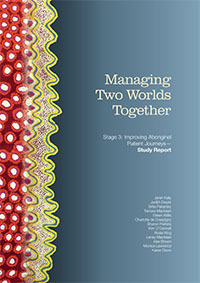
- Kelly, J., Dwyer, J., Pekarsky, B., Mackean, T., Willis, E., de Crespigny, C., Perkins, S., O’Donnell, K., King, R., Mackean, L., Brown, A., Lawrence, M. & Dixon, K. 2015, Managing Two Worlds Together (Stage 3): Improving Aboriginal Patient Journeys – Study Report, The Lowitja Institute, Melbourne
- Kelly, J., Dwyer, J., Pekarsky, B., Mackean, T., McCabe, N., Wiseman, J., de Crespigny, C. & O’Donnell, K. 2015, Managing Two Worlds Together (Stage 3): Improving Aboriginal Patient Journeys – Workbook (Version 1), The Lowitja Institute, Melbourne
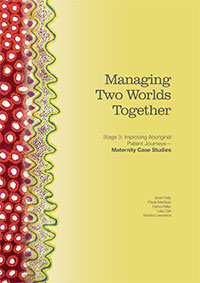
- Kelly, J., Medway, P., Miller, D., Catt, L. & Lawrence, M. 2015, Managing Two Worlds Together (Stage 3): Improving Aboriginal Patient Journeys – Maternity Case Studies, The Lowitja Institute, Melbourne
- Kelly, J., Herman, K., Martin, G., Wilden, C., East, T., Russell, C. & Brown, S. 2015, Managing Two Worlds Together (Stage 3): Improving Aboriginal Patient Journeys – Renal Case Studies, The Lowitja Institute, Melbourne
- Kelly, J., Ramage, M., Perry, D., Tinsley, J., Auckram, H., Corkhill, W., Wyatt, S. & McCabe, N. 2015, Managing Two Worlds Together (Stage 3): Improving Aboriginal Patient Journeys – Rural and Remote Sites Case Studies, The Lowitja Institute, Melbourne
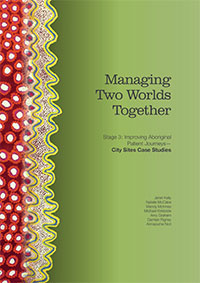
- Kelly, J., McCabe, N., McInnes, W., Kirkbride, M., Graham, A., Rigney, D. & Nori, A. 2015, Managing Two Worlds Together (Stage 3): Improving Aboriginal Patient Journeys – City Sites Case Studies, The Lowitja Institute, Melbourne
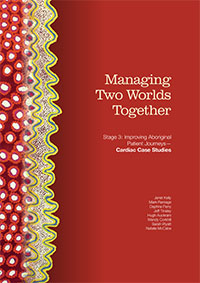
- Kelly, J., Ramage, M., Perry, D., Tinsley, J., Auckram, H., Corkhill, W., Wyatt, S. & McCabe, N. 2015, Managing Two Worlds Together (Stage 3): Improving Aboriginal Patient Journeys – Cardiac Case Studies, The Lowitja Institute, Melbourne.
Stages 1 and 2 publications:
- J. Dwyer, J. Kelly, E. Willis, J. Glover, T. Mackean, B. Pekarsky & M. Battersby 2011, Managing Two Worlds Together: City Hospital Care for Country Aboriginal People—Community Summary, The Lowitja Institute, Melbourne
- J. Dwyer, J. Kelly, E. Willis, J. Glover, T. Mackean, B. Pekarsky & M. Battersby 2011, Managing Two Worlds Together: City Hospital Care for Country Aboriginal People—Project Report, The Lowitja Institute, Melbourne
- J. Glover & M. Freeman 2011, Managing Two Worlds Together: Study 1—Report on Admissions and Costs, The Lowitja Institute, Melbourne
- J. Dwyer, J. Kelly, E. Willis, T. Mackean, M. Battersby, B. Pekarsky & J. Glover 2011, Managing Two Worlds Together: Study 2—Staff Perspectives on Care for Country Aboriginal Patients, The Lowitja Institute, Melbourne
- J. Kelly, J. Dwyer, T. Mackean, E. Willis, K. O’Donnell, M. Battersby & B. Pekarsky 2011, Managing Two Worlds Together: Study 3—The Experiences of Patients and Their Carers, The Lowitja Institute, Melbourne
- J. Kelly, B. Pekarsky, J. Dwyer, T. Mackean, E. Willis, J. Glover & M. Battersby 2011, Managing Two Worlds Together: Study 4—Complex Country Aboriginal Patient Journeys, The Lowitja Institute, Melbourne
- J. Kelly, J. Dwyer, B. Pekarsky, T. Mackean, E. Willis, M. Battersby & J. Glover 2012, Managing Two Worlds Together: Stage 2 – Patient Journey Mapping Tools, The Lowitja Institute, Melbourne.
